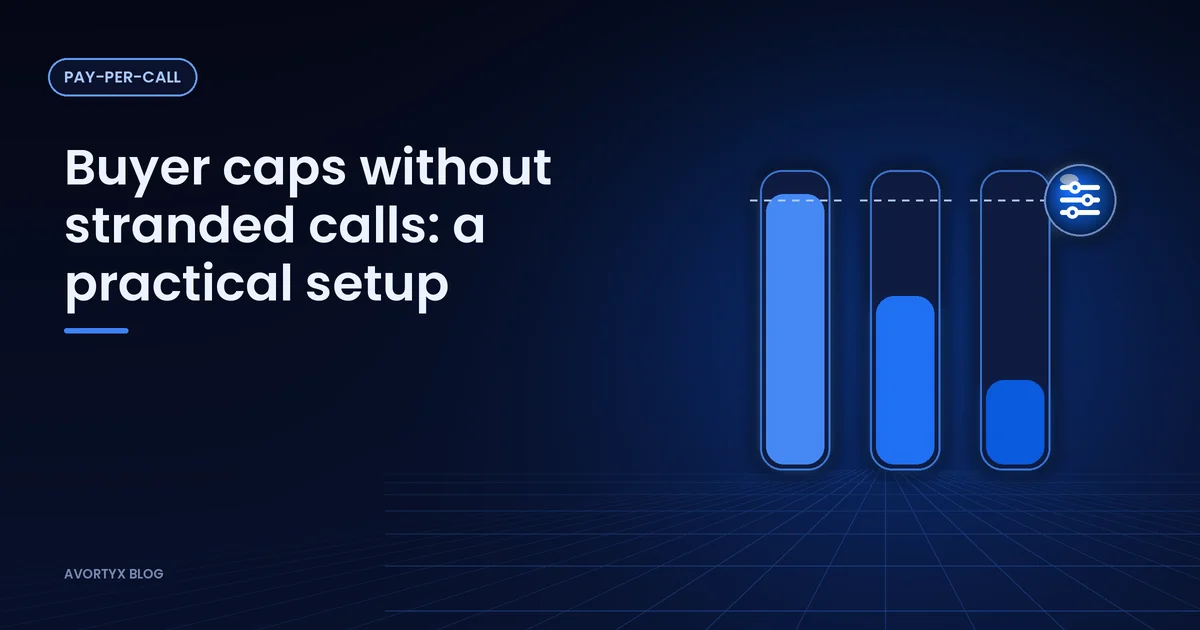
A cap tells the platform when a buyer has had enough: a number of calls per day, per hour or at the same time. Caps keep buyers happy, but caps that are too tight, or that all run out together, leave good calls with no destination.
Three kinds of cap
- Daily or monthly caps limit total volume.
- Hourly caps spread a buyer’s calls across the day.
- Concurrency caps limit how many live calls a buyer takes at once, usually matching their free agents.
Stagger capacity across buyers
If every buyer is full by midday, the afternoon’s calls fail. Combine buyers with different hours and different caps, so there is always somewhere for a call to go.
- Buyer A
- 150 calls a day, full by 1pm
- Buyer B
- 80 calls a day, open 9am to 9pm
- Buyer C
- 20 concurrent calls, no daily cap
- Result
- After 1pm, calls still have two buyers to reach
Illustrative figures.
Find the hour calls start failing
Chart connect rate hour by hour. A drop at the same time every day is nearly always a cap, not a traffic problem. Lifting one buyer’s cap, or adding a buyer for that window, wins those calls back.
Fail over instead of failing
When a buyer is full or misses the ring, the next eligible buyer should ring immediately. Failover turns a capped buyer from a lost call into, at worst, a slightly cheaper one.
In Avortyx, buyer match rules, caps, hours and concurrency are checked on every call, with failover when a buyer misses.
See it in your own numbers. Know where each call came from, send it to a buyer who can take it, and see what it earned.