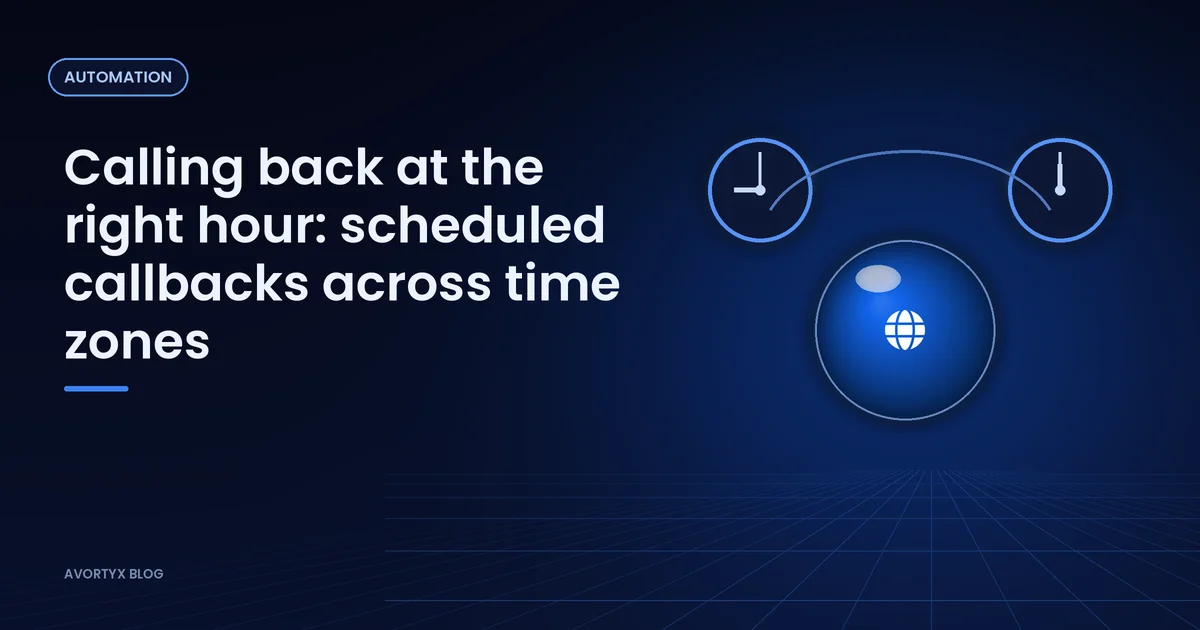
A form that says “call me tomorrow morning” sounds clear until the lead is three time zones away. Call at 9am office time and you might wake them at 6.
Keep the lead’s time zone
Work it out once, when the lead arrives, from their area code, ZIP or the details they entered, and store it with the lead. Every later step, from the first call to the last retry, can then be planned in their local time.
Plan every attempt, not just the first
A callback sequence usually has several steps: a call, a text if it is missed, another call later in the day, a last try the next morning. Space them so each lands at a sensible local hour, and stop the sequence the moment the lead answers or converts.
- The first attempt at the requested time, in the lead’s zone.
- A text right after a missed call, if the lead agreed to texts.
- Retries spread through the day, never back to back.
- Asked for
- Tomorrow, 9am their time
- Attempt 1
- 9:00 Phoenix, 12:00 New York
- Missed
- Text sent, retry at 1:30pm Phoenix
- Stopped
- The lead answers attempt 2
Illustrative schedule.
Let the rules decide
Calling hours, holidays and contact limits vary by state. Measure every window in the lead’s own time zone, and let a step wait rather than fire outside it.
Avortyx lead automation runs SMS, email and outbound call sequences with conditional branching, retry logic and scheduled callbacks with daylight-hours awareness, and state rules measure calling windows in the lead’s own time zone.
See it in your own numbers. Know where each call came from, send it to a buyer who can take it, and see what it earned.